Northern Gateway Oil Pipeline Project (Canada)
Last modified: 12th August 2019
(Note: This article was up-to-date as of August 2012 and has not been maintained since)
Summary
The Canadian Northern Gateway Pipeline Project has proposed a pair of 1,200 km pipelines that would link the tar sand oil fields of northern Alberta with a marine port in British Columbia. Supporters of the project emphasize the opportunity to open up new markets (primarily Asia) for Canadian oil, provide a large number of construction jobs across a wide region, and supply a source of ongoing revenue and employment along the line. Opponents object to the environmental impacts of the pipeline, the potential for increased extraction of tar sands in Alberta, an increase in the price of oil, impacts of increased ship traffic in BC waters, and the risk of a major spill, either on land or at sea.
Project Overview
If approved, the westbound pipeline of this project would transmit around 525,000 barrels of oil per day. The eastbound pipeline would transmit 193,000 barrels per day of a petroleum byproduct called condensate, which is used to thin tar sands crude oil for transport. The project plans to locate the eastern terminus of the pipeline in the refinery town of Bruderheim, Alberta, and the western terminus in the deepwater port of Kitimat, British Columbia. Capital costs of the project are expected to be in the range of $5.5 billion Canadian dollars, including the construction of port facilities in Kitimat. A report released in 2012 concluded that the project would raise the price of oil by $2-$3 per barrel and have a net negative economic impact for Canada, a finding that has been disputed by Enbridge.
Enbridge Northern Gateway Pipelines, a subsidiary of the Calgary-based Enbridge Inc., is undertaking the project. Enbridge is also responsible for a pipeline that suffered a major leak in Michigan in July 2010, discharging over 800,000 gallons of crude oil into a river. In June 2012 an Enbridge pumping station spilled over 60,000 gallons of crude oil in Alberta. Environmentalists have argued that the company has a poor safety and environmental record. Public pressure resulting from the Wisconsin spill and Alberta spills may reduce the chances of regulatory approval for the Northern Gateway Pipeline project.
Environmental Concerns
Opponents of the project are primarily concerned with the direct effects of the pipeline itself, the impacts of increased ship traffic on the BC coast, and the risks of a major oil spill from the pipeline or the associated oil tankers. Additionally, the existence of the pipeline may encourage increased oil extraction from Alberta tar sands, a process that employs massive surface mines, uses large amounts of water, and emits 2-4 times as many greenhouse gases as conventional oil. The products produced by tar sands extraction also create unique problems. Both the “synthetic crude” and “diluted bitumen” produced are much less well-studied than traditional crude and present unique challenges in terms of transport and spill response.
Impacts of the pipeline
Enbridge claims they can compensate for any impact of the project through their “Neutral Footprint Program,” which aspires to:
“Plant a tree for every merchantable tree we remove. Help to conserve an acre (or hectare) of land for every acre (or hectare) of natural habitat we permanently impact. Generate a kilowatt hour of renewable energy for every kilowatt hour of power our operations consume.”
Many local communities and indigenous groups are, nonetheless, opposed to the route of the pipeline. Several groups have expressed concerns regarding the environmental aspects of the pipeline, as well as reservations regarding the right-of-way issues of passing over indigenous lands. A majority of tribes along the pipeline route are opposed, in particular tribal groups in British Columbia. However, several tribes such as the Gitxsan First Nation have come out in favor of the project and the associated benefits.
Increased ship traffic
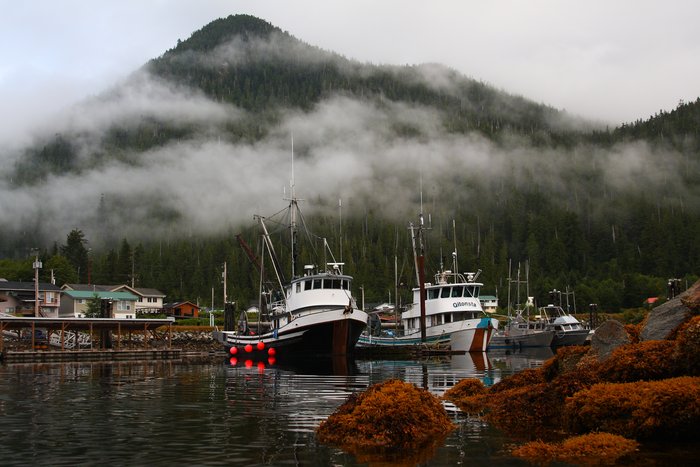
The project estimates an increase in oil tanker traffic of up to 220 ships per year, passing through rocky and relatively pristine parts of Caamano sound and Wright Sound. Scientists have voiced concerns about the negative impacts of noise and ship strikes on resident whale populations and their migration routes. However, the predominant worry is the dramatically increased risk of a marine oil spill, with a “hazard zone” six times longer than in Price William Sound. Experts have highlighted the fact that the tanker route presents numerous navigational hazards. In 2006, a large passenger ferry called the Queen of the North ran aground along the same route that oil tankers would use. Then in 2011 a tanker called the M/V Petersfield also ran aground in Douglas Channel after leaving Kitimat. A political and legal conflict with a 1972 moratorium on oil tankers passing through BC waters may or may not apply to this project. Some have argued that the moratorium only applies to US-bound tankers coming from Alaska that are transiting through BC waters, while others have suggested that the moratorium applies to any oil tanker traffic in BC. Additional efforts to unambiguously ban tanker traffic in the area have been proposed, but none have succeeded to date.

Risks of oil spills
As demonstrated by the infamous Exxon Valdez disaster in Prince William Sound, Alaska, marine oil spills can have serious and long-lasting impacts on entire ecosystems. Consequences include the death of marine mammals, fish, and birds as well as longer-term negative impacts on reproductive rates and the viability of eggs and larvae in the water. Oil degrades more slowly in cold water, and could persist for decades in places like Caamano and Wright Sound. A large increase in oil tanker traffic in Caamano Sound resulting from the existence of the Northern Gateway pipeline would raise the risk of having a major spill in the area.
While an oil spill on land may be easier to contain, the environmental impacts, both short-term and long-term, are not minor. The July 2010 spill from the Enbridge pipeline in Michigan took months to clean up, and polluted a large section of a productive river. Because this spill was located in a populated area, the response to the spill was rapid, and it was contained quickly. The Northern Gateway pipeline would pass through large portions of relatively inaccessible wilderness that could delay the speed and effectiveness of the response to a spill. A even less remote spill in May 2010 on the similar Trans-Alaska Pipeline still spilled thousands of barrels of crude oil onto the tundra before detection of the leak and the shutdown of the pipeline. These sorts of spills are of particular concern to this project, because one of the products being transmitted through the pipeline (sulfur-rich bitumen) is particularly corrosive. This is further complicated by the fact that the pipeline will be buried, making detection of leaks more problematic than normal.
Current status
The project began the official regulatory process in May 2010. Since the potential environmental impact of the project could be quite large, the review is taking place through a special joint review panel process that is expected to take around two years. In January 2011, the panel requested more information from Enbridge before proceeding with the review.
The decision in November 2011 by the Obama administration to delay consideration of the Keystone XL expansion in the U.S. has focused even more attention on the Northern Gateway Pipeline project. Also in November, the joint review panel announced a series of community hearings in affected areas, starting in Kitimat in January 2012.
In December 2011, the review panel announced that they would not reach a decision until the end of 2013, a year behind schedule.
Further Reading
- > Wikipedia article on "Enbridge Northern Gateway Pipelines"
- > "Pipeline and Tanker Trouble" report (2011) produced by the Pembia Institute, National Resource Defense Council, and Living Oceans.
- > Enbridge Northern Gateway Project Joint Review Panel website
- > Enbridge Northern Gateway Pipelines company website
Created: Jan. 19, 2018